Why Your Dead Stock Quotation Looks Lower Than You Expected
You expected one number. The quotation says something else, and lower. That gap is the reason most dead stock deals stall before they close.
Here's the part that usually gets missed in that moment: the gap is rarely arbitrary. A quotation is built from a specific set of factors, and once you know what they are, you can tell the difference between a fair offer and one worth pushing back on.
The Three Numbers Sellers Confuse
Most disappointment starts with comparing the wrong two numbers.
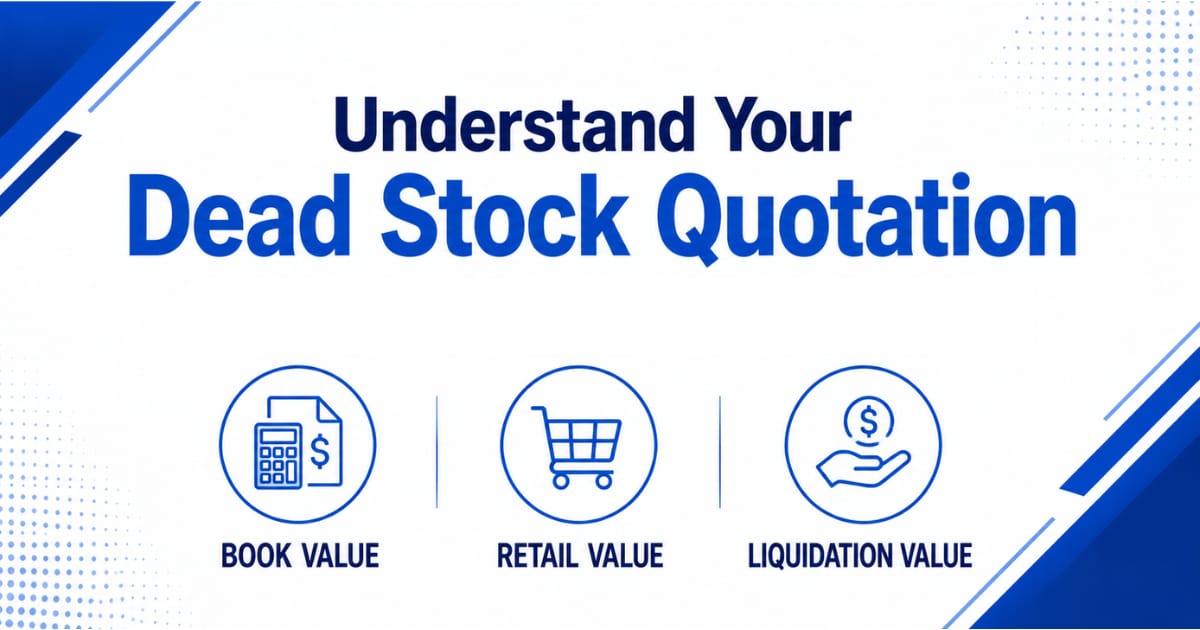
Book value is what your accounts say the stock is worth, usually based on original purchase price minus depreciation. Retail value is what the stock would sell for new, to a normal customer, at full price. Neither of these is what a dead stock buyer can pay.
Liquidation value is the number that actually applies. It reflects what the stock is worth right now, to a buyer who has to move it quickly, often in bulk, often without the packaging, warranty, or brand positioning that supported the retail price in the first place. A quotation is built on liquidation value, not book value or retail value, and that alone explains most of the gap sellers notice.
What Actually Gets Deducted From Your Offer
A quotation isn't one number pulled from a market average. It's liquidation value, minus a set of specific deductions.
| Deduction | Why It Exists | Typical Range |
| Condition adjustment | Damaged, expired, or degraded stock costs more to move | 5 to 20 percent |
| Handling and sorting | Mixed lots need to be sorted, checked, and categorized before resale | 3 to 10 percent |
| Category demand | Some categories move faster than others in the current market | 5 to 25 percent |
| Age depreciation | Older stock competes with newer inventory in the resale market | 5 to 15 percent |
| Logistics and collection | Site access, packaging condition, and volume affect collection cost | 2 to 8 percent |
Not every deduction applies to every lot. A well-organized, single-category lot in good condition will sit near the low end of every range. A mixed, aged, or hard-to-access lot will sit near the high end.
What You Can Negotiate
Some parts of a quotation genuinely have room to move.
- How clearly the stock is sorted and documented before collection
- Whether you can offer exclusivity or a faster decision timeline
- How flexible you can be on collection access and scheduling
- Whether the lot is presented as a single category instead of mixed
Improving any of these can shift the deduction side of the equation in your favor, sometimes meaningfully.
What You Cannot Negotiate
Some parts of the number are fixed, and a good buyer will tell you that plainly instead of pretending otherwise.
Commodity and scrap pricing follows the market on the day, not the buyer's preference. Category demand reflects what is actually moving right now, not what moved well two years ago. Age-based depreciation is a straight calculation, not a judgment call. Pushing on these particular points will not change the outcome, and a buyer who claims otherwise is usually managing your expectations rather than your price.
A Worked Example
A seller has 200 units of electronics accessories, two years old, mixed condition, stored in original boxes. Retail value new: roughly AED 40 per unit, or AED 8,000 total. Liquidation value, given current category demand: closer to AED 18 per unit, or AED 3,600. After a 10 percent condition adjustment and 5 percent handling deduction, the quotation lands around AED 3,060.
That's well below the AED 8,000 retail figure the seller may have been anchoring to, but it's a fair reflection of liquidation value once demand, condition, and handling are accounted for, not an arbitrary lowball.
Ask your buyer to show their working, not just their number. A quotation you can't break down into its parts is a quotation you can't evaluate.
When a Lower Offer Is Actually the Right Offer
Sometimes the honest answer is that the lower number is correct. If the stock is aged, the category has softened, or the lot needs significant sorting, a lower quotation isn't a negotiating position. It's an accurate one. The goal of understanding the breakdown isn't to argue every number down further. It's to know which parts are worth a conversation and which parts simply reflect where the market sits today.
FAQs
Why is my dead stock offer lower than what I originally paid?
Your original purchase price reflects retail or wholesale value at the time of buying. A quotation reflects liquidation value today, which accounts for current demand, condition, and resale cost, so a gap is expected rather than unusual.
Is there room to negotiate a dead stock quotation?
Yes, on specific elements like sorting, documentation, collection flexibility, and timeline. Market-driven factors like commodity pricing and category demand are not negotiable.
What's the difference between book value and liquidation value?
Book value is an accounting figure based on original cost and depreciation. Liquidation value is what the stock can realistically be sold for quickly, in bulk, in its current condition, which is almost always a lower number.
Why do buyers deduct handling or sorting costs from an offer?
Mixed or unsorted lots require inspection, sorting, and categorization before they can be resold. That labor has a cost, and it's built into the quotation rather than hidden.
Should I get a second quotation before accepting an offer?
It's reasonable to compare, especially if a buyer won't explain their breakdown. A second opinion is most useful when you can compare the actual line items, not just the final number.
Conclusion
A quotation that looks lower than expected isn't automatically a lowball. Once you can see book value, retail value, and liquidation value as three separate things, and once you know which deductions are negotiable and which ones aren't, the number in front of you stops being a mystery.
Request a valuation and ask for a full line-item breakdown, not just a final figure. A transparent quotation is one you can actually evaluate.