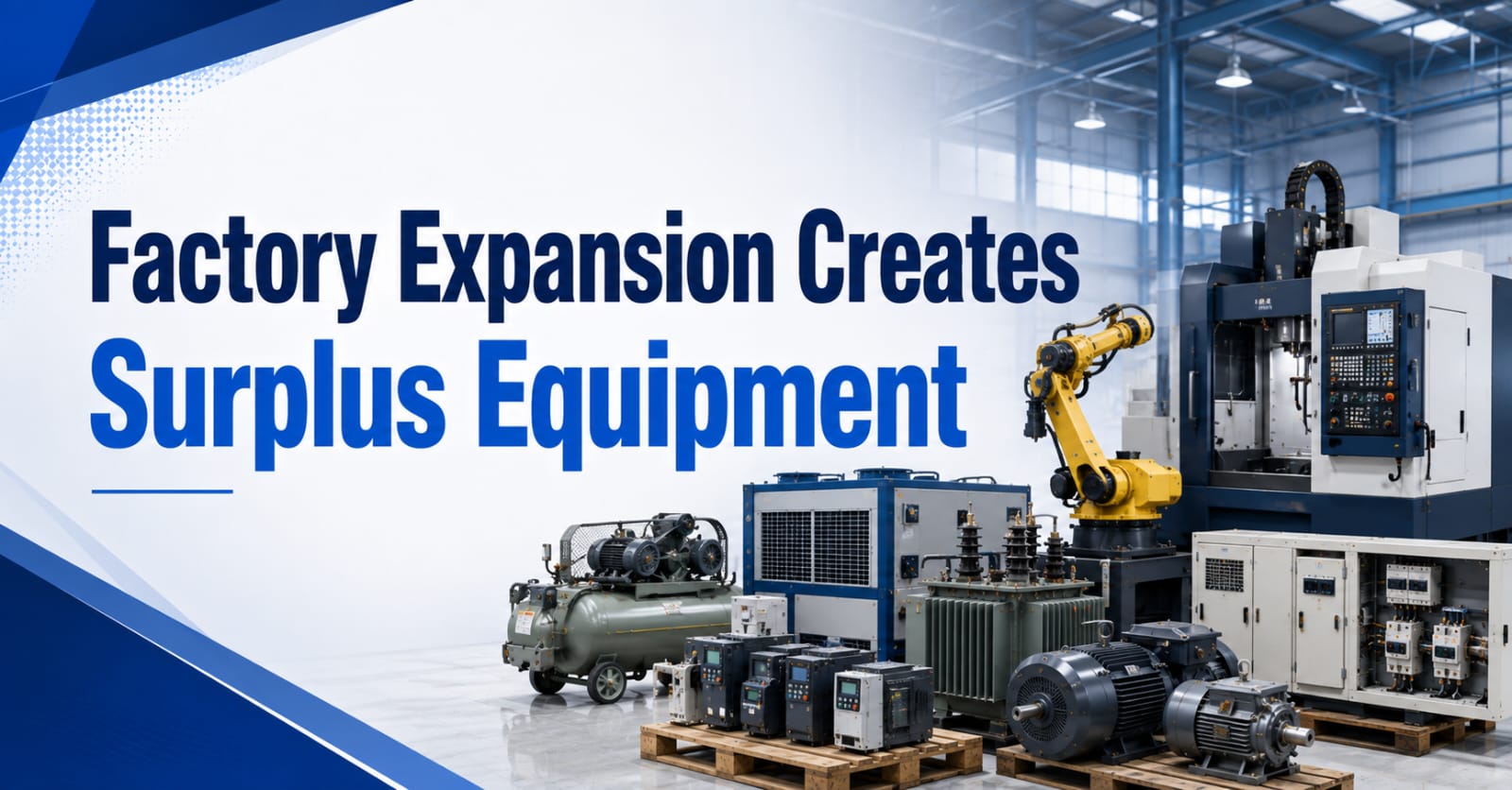
What Happens to Surplus Industrial Equipment After Factory Expansion Projects in Kuwait
A factory expansion in Kuwait rarely ends with a clean site. Somewhere between the old floor plan and the new one, equipment gets left standing that has no place in either. Understanding how that happens says a lot about how industrial growth actually works on the ground, not just on paper.
This pattern repeats across nearly every expansion, regardless of the industry involved. The specifics differ, but the underlying mechanics, timing mismatches, replacement logic, and administrative lag, tend to look remarkably similar from one plant to the next.
Expansion Changes the Floor Plan Before It Changes the Equipment
When a plant expands, the new layout is usually designed around higher output, not around reusing every existing machine. Engineers plan the new line first, then work out which of the old assets fit into it. Anything that does not fit, whether because of size, throughput, or compatibility with new automation, gets set aside.
This creates a gap between the expansion timeline and the equipment retirement timeline. The new equipment arrives and gets commissioned on a fixed schedule. The old equipment it replaces does not have the same urgency attached to a decision, so it tends to sit in a corner of the plant while other priorities take precedence.
This gap widens further when an expansion is phased rather than delivered all at once. A plant might commission a new section while an older section keeps running for months in parallel, which means retired equipment from the new section sits alongside active equipment from the old one, making it harder for staff to distinguish what is genuinely surplus from what is simply between uses.
Modernization Replaces Equipment Long Before It Wears Out
Plant modernization in Kuwait is often driven by efficiency and compliance targets rather than equipment failure. A machine running at 70 percent efficiency still works, but it no longer meets the output or energy standards the business is targeting. Replacing it makes financial sense even though the unit itself has years of working life left.
This is a different pattern from a machine simply breaking down. Equipment retired for modernization reasons is usually complete, functional, and often still under some form of maintenance record, which is part of why it does not get scrapped immediately. Someone in the plant knows it still has value, even if nobody has assigned it a next step.
Regulatory alignment plays a role too. As industrial standards in Kuwait evolve around energy efficiency and emissions, plants sometimes replace equipment ahead of schedule specifically to stay compliant with updated requirements, rather than waiting for the original unit to reach end of life on its own terms.
Production Line Upgrades Leave a Trail of Idle Assets
Upgrading a single production line rarely happens in isolation. Conveyor systems, control panels, motors, and supporting equipment are often specified as a package, so replacing the core process equipment usually means replacing the equipment around it too, even where the older peripherals could technically keep running.
The result is a set of assets retired together, all at roughly the same functional condition, which is different from the gradual, piece-by-piece obsolescence seen in older equipment failures. Plants that go through several upgrade cycles over the years accumulate these batches, each one from a different phase of the plant's modernization history.
Staff familiarity adds a quieter complication. Operators trained on the older line configuration sometimes keep spare parts and tools for it on hand out of habit, even after the new line is fully commissioned, which extends how long peripheral equipment stays visible on site rather than being formally cleared.
Asset Relocation During Expansion Creates Its Own Surplus
Expansion inside an existing site, or a move to a larger facility elsewhere in Kuwait's industrial zones, forces a physical decision about every piece of equipment on the floor: does it move, or does it stay. Relocation costs, including transport, reinstallation, and recalibration, mean older or lower-value equipment often gets left behind rather than moved, even if it is still working.
This is a distinct driver from modernization. The equipment is not necessarily obsolete. It is simply not worth the cost of moving relative to its value, particularly for bulkier machinery where transport alone can exceed a large share of the asset's remaining worth.
Distance factors into this decision more than most plants account for upfront. Moving equipment within the same industrial area is a very different cost calculation from relocating it to a new site further out, and expansion projects that involve a genuine site change tend to leave far more equipment behind than an expansion that simply adds capacity to an existing footprint.
Equipment Retirement Is a Decision, Not an Event
It is easy to assume equipment gets retired the moment it stops being used, but in practice retirement is usually a slower administrative process. The machine stops running, but it stays on the asset register. Someone has to formally decide to remove it from active service, which often waits for a broader review, an audit, or a change in plant management, rather than happening automatically.
This lag between an asset going idle and an asset being formally retired is one of the main reasons factories in Kuwait accumulate visible surplus after an expansion project rather than resolving it as part of the project itself. The expansion team is focused on getting the new line running. Retiring the old equipment properly is a separate task that tends to fall to whoever is left managing the plant once the project team has moved on.
In practice, this often means the equipment sits through at least one full financial cycle before it gets addressed. Plant managers frequently wait for a scheduled asset audit or a change in leadership to force the decision, rather than treating retirement as a task that belongs on the expansion project's own closing checklist.
Recognizing these patterns, floor plan mismatch, modernization ahead of failure, batch upgrades, relocation cost decisions, and slow formal retirement, helps plant managers anticipate surplus earlier in an expansion project rather than discovering it fully formed once the new line is already running. Building a retirement checkpoint into the expansion project plan itself, rather than treating it as a separate task for later, is the clearest way to close that gap. If you're evaluating what to do with equipment left over from your own expansion, WBDS's industrial equipment buyer Kuwait page covers how that process works.
FAQ
Why does equipment still in working condition get retired during an expansion? Because expansion and modernization projects are usually judged against efficiency, output, and compatibility targets, not against whether the existing machine still functions. A working machine can still fall short of the new targets.
Does every production line upgrade replace the surrounding equipment too?
Often, yes. Core process equipment and its supporting systems, such as conveyors and control panels, are frequently specified as one package, so upgrading the core usually means retiring the peripherals as well.
Why does surplus equipment sit around instead of being retired immediately?
Formal retirement is an administrative decision, not an automatic outcome of a machine going idle. It typically waits for a review, audit, or change in plant leadership rather than happening the moment the equipment stops running.
Is relocation surplus the same as modernization surplus?
No. Modernization surplus comes from equipment being outperformed by newer alternatives. Relocation surplus comes from a cost decision, moving an asset is not always worth what it costs relative to the asset's value, even when the equipment itself is still functional.