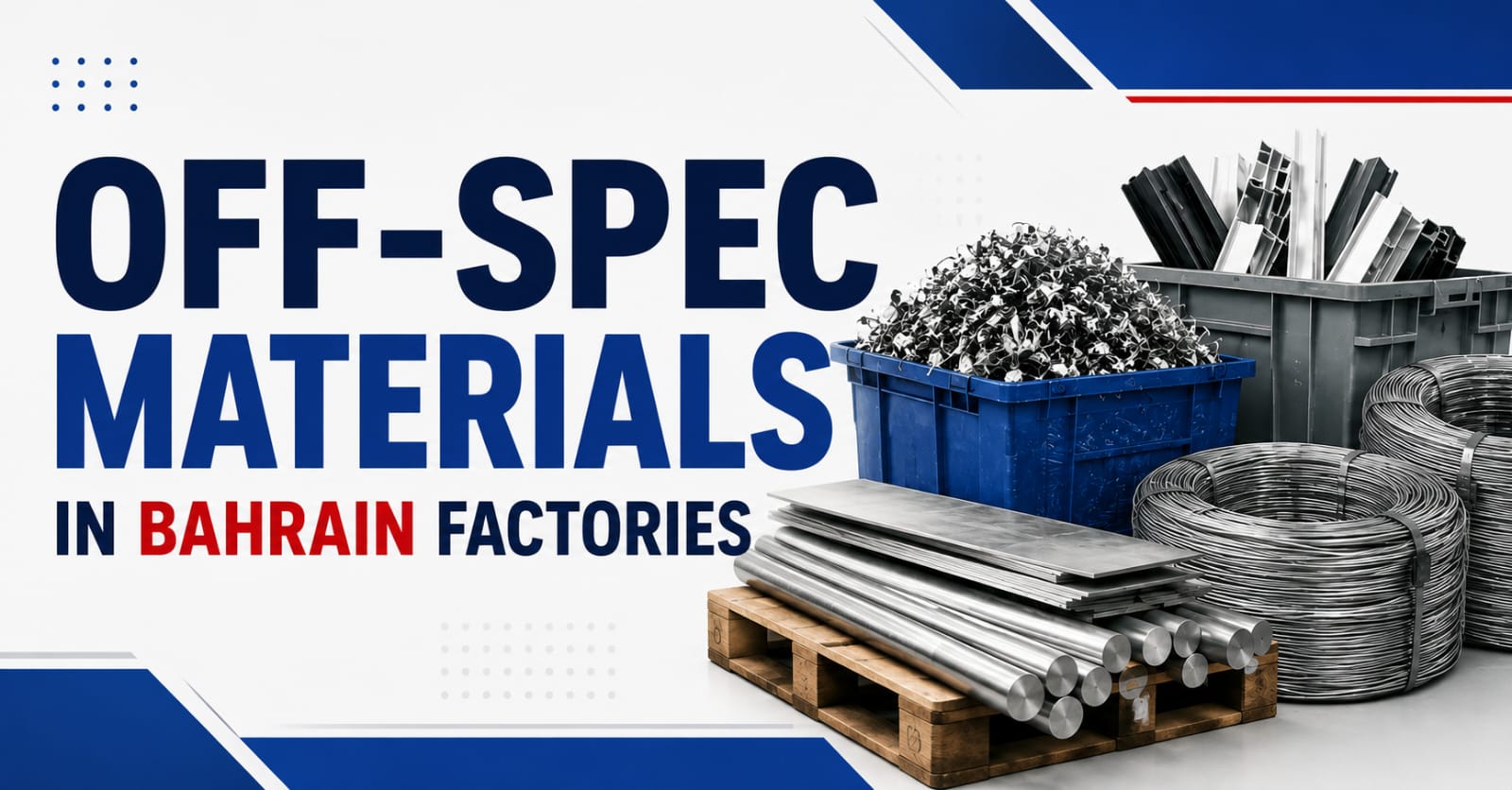
Surplus and Off-Spec Stock in Bahrain's Manufacturing Sector
A manufacturer in Bahrain rarely plans to end up with off-spec material sitting in a corner of the plant. It happens because production runs to a customer's spec, and once that order is cancelled, revised or completed, the material left over does not match anything else on the floor. In a compact industrial base like Bahrain's, where Salman Industrial City and Bahrain International Investment Park host a mix of aluminium downstream fabricators and light manufacturers, this pattern shows up often and gets handled inconsistently.
Why Off-Spec Stock Builds Up
Aluminium downstream production tied to Alba's supply chain runs on tight tolerances. Coil, sheet or extrusion cut to a specific gauge or finish for one customer has limited use elsewhere if that customer changes the order or the contract ends. The same happens with packaging and fittings ordered against a spec that gets revised mid-project. On the contractor side, work linked to BAPCO's refinery modernization often involves procuring materials against a defined scope. When that scope shifts or closes out early, whatever was ordered ahead of schedule becomes surplus with no active project to absorb it.
What Holding It Actually Costs
Off-spec stock takes up floor space that a small facility cannot always spare. It shows up on inventory counts and can complicate an audit if nobody has decided whether it is an asset or a write-off. Left in open storage, aluminium and metal components are also exposed to corrosion risk in Bahrain's humidity, which reduces whatever resale value the material still has. None of this is dramatic on its own, but it adds up when a manufacturer is also trying to keep production space clear for active orders.
Off-Spec Is Not the Same as Scrap
A common mistake is treating off-spec material the same way as scrap. Off-spec stock is usually still usable, just not to the original specification. Scrap yards price by weight and metal type, which undervalues material that could otherwise be sold as a lot to a buyer who deals in surplus rather than recyclable metal. Knowing the difference before deciding where to send the material affects how much of its value gets recovered.
How Bahrain's Manufacturing Footprint Shapes This
Bahrain's manufacturing sector is smaller than Saudi Arabia's or Qatar's, and facilities inside Salman Industrial City and BIIP tend to run leaner layouts with less spare storage. That means off-spec stock gets noticed faster than it might in a larger facility with room to let it sit, but it also means there is less internal capacity to manage or repurpose it. A fabricator working near full floor capacity has more incentive to move surplus out quickly rather than store it indefinitely.
A Practical Example
Consider a fabricator in Salman Industrial City producing coil-fed components against a specific customer order. Midway through the run, the customer revises the finish requirement. The coil already cut to the old spec no longer matches any current order, and there is no obvious next buyer for a partial batch that does not match standard stock sizes. It sits until someone decides what to do with it, usually once storage becomes tight enough to force the decision.
FAQs
What causes off-spec stock in Bahrain's aluminium downstream sector?
Most off-spec stock comes from production cut or finished to a customer specification that later changes, gets cancelled, or is completed early, leaving material that does not match other active orders.
Is off-spec material the same as scrap?
No. Off-spec material is usually still usable and can carry more value than scrap pricing reflects, since scrap yards price by weight rather than by the material's actual condition or use.
How should a manufacturer store off-spec stock while deciding what to do with it? Keeping it dry, off the floor and separated from active production stock limits corrosion and reduces the chance it gets mixed into inventory counts by mistake.
Can off-spec material from a BAPCO-linked contractor project be sold as a single lot? Yes. Surplus material from a closed-out project scope can typically be sold together rather than itemized, which is usually faster than trying to place individual components.
Conclusion
Off-spec and surplus stock in Bahrain's manufacturing sector is mostly a byproduct of how tightly production runs to customer spec. It is not scrap, and treating it that way leaves value on the table. Once a facility decides the material is not going to be used internally, the next question is simply how to move it out without the process taking longer than the storage problem it is solving.
If your facility in Salman Industrial City or BIIP is holding off-spec or surplus material, WBDS can review it as a lot and provide a valuation. See how the process works on the Dead Stock Buyer Bahrain page.