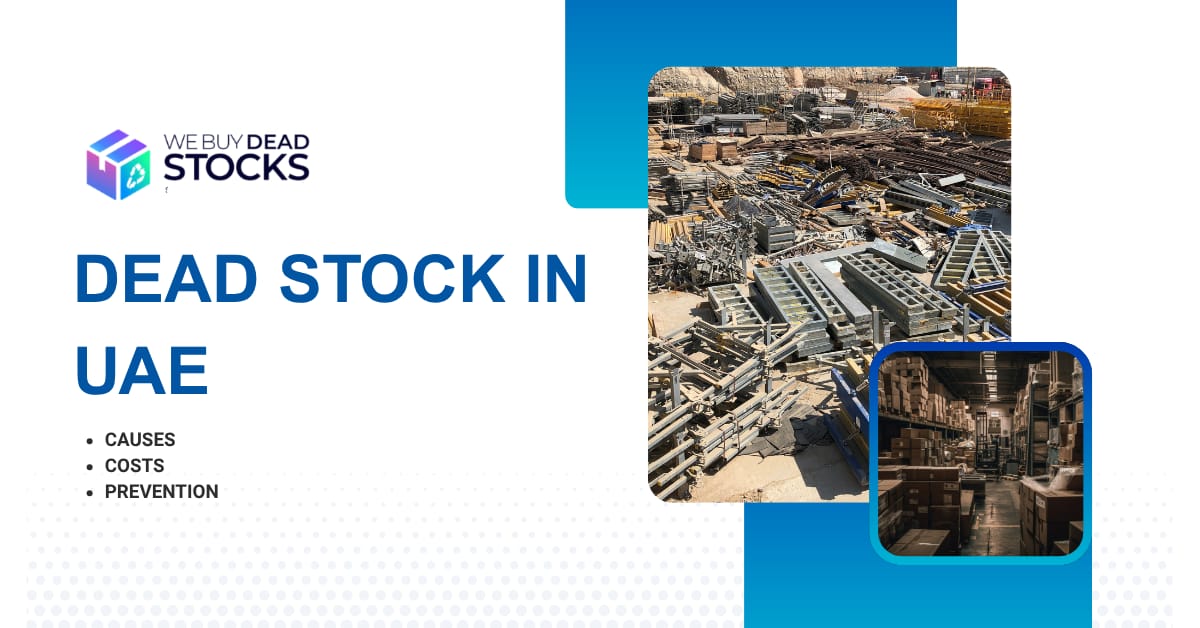
Dead Stock Management in UAE: Causes, Costs and How to Prevent It
Dead stock builds quietly. It does not announce itself. One quarter you have a healthy warehouse, and the next you are looking at shelves of product that has not moved in months, with no clear path for what to do with it.
This guide is for procurement managers, warehouse heads, and operations teams who want to understand what causes dead stock, what it is actually costing the business, and how to stop it building up in the first place.
What Is Dead Stock?
Dead stock is inventory that has stopped selling and is unlikely to sell through normal channels at full price, at a discount, or in any standard transaction. It is not slow-moving stock. It is not low-priority stock. It is stock that has effectively stopped generating any return while continuing to consume space and capital.
In the UAE context, dead stock typically falls into one of four categories.
Project remnants are materials ordered for a specific contract that was cancelled, reduced in scope, or handed to a different supplier. The goods arrive correctly, but the project that needed them no longer exists in its original form.
Discontinued lines are products that the manufacturer or brand has stopped producing or that the business has decided to stop stocking. The remaining units have no reorder pipeline and gradually become harder to move.
Superseded components appear frequently in electrical, IT, and industrial categories. A newer model replaces an older one, and anything ordered under the previous specification becomes difficult to shift.
Seasonal stock that missed its window is common in retail-adjacent businesses. Goods ordered for Ramadan, summer, or year-end campaigns that arrived late or in excess of actual demand.
Dead Stock vs Slow-Moving Inventory
These two are often confused, and the distinction matters because the management response is completely different.
Slow-moving inventory is still transacting, just at a pace that does not justify the space and capital it ties up. It can often be redirected through existing channels with some effort.
Dead stock has stopped transacting entirely. It requires a different approach, and waiting for slow-movers to become dead stock before acting consistently produces worse outcomes. For a detailed breakdown of the difference, our dead stock guide covers both terms clearly.
Why Dead Stock Builds Up in UAE Businesses
Understanding the cause is the only way to prevent recurrence. Most dead stock does not appear because of bad decisions. It appears because of reasonable decisions made with incomplete information, under supplier pressure, or without a system to catch the problem early.
Over-Ordering to Meet MOQs
Supplier minimum order quantities are one of the most consistent causes of dead stock in the UAE market. A business needs 200 units but the MOQ is 500. The extra 300 arrive, absorb shelf space, and sit there after the original demand is fulfilled.
The fix is not to avoid volume pricing. It is to negotiate return clauses before the order is placed, or to find a secondary buyer for the surplus before it becomes dead stock.
Demand Forecasting Errors
Orders based on historical sales data, supplier recommendations, or optimistic projections rather than real-time demand signals. In categories like IT hardware, construction materials, and electronics, market conditions move fast enough that a three-month-old forecast can be significantly off.
The practical response is shortening the forecasting window and building buffer logic that reflects actual sales velocity rather than hoped-for velocity.
Cancelled or Reduced Downstream Orders
A client reduces project scope. A contractor loses a contract. A retailer cuts a product line. The materials already purchased remain in your warehouse with no demand to absorb them.
This is largely outside a business's control, but supplier agreements with return or exchange provisions provide at least partial protection when it happens.
Product Discontinuation Without a Clearance Process
When a manufacturer stops producing a component, or when the business decides to exit a product category, the remaining stock needs an active exit plan. Without one, it defaults to dead stock by inaction rather than by design.
A formal product lifecycle process, including a defined exit trigger and a clearance procedure, closes this gap.
Poor Inventory Visibility
Stock that is not tracked accurately gets forgotten. Items move to back-of-warehouse locations, drop off active cycle counts, and stop being offered to customers or included in purchasing decisions. The business does not know it has the stock; it keeps buying elsewhere.
This is increasingly easy to solve with inventory management systems, but the discipline of regular reconciliation between system data and physical count is what actually prevents the problem.
SKU Overload
Maintaining too many product variants fragments sales across a large range. Slower variants never accumulate enough velocity to clear, and the range keeps growing without anything being retired. A regular SKU rationalisation review, typically quarterly or biannual, keeps the range manageable.
What Dead Stock Is Costing You
Most businesses underestimate the financial impact because they measure it only at purchase cost. The actual cost is significantly higher.
Capital lock-up is the most direct impact. Every dirham tied up in non-moving inventory is unavailable for reinvestment. A business carrying AED 300,000 in dead stock is running an interest-free loan to a product that generates nothing.
Storage and holding costs in the UAE are substantial. Industrial and warehouse space in Dubai, Abu Dhabi, and Sharjah carries meaningful cost per square metre. Industry benchmarks put annual holding costs at 20 to 40 percent of the stock's value when rent, utilities, insurance, and handling are factored in.
Depreciation compounds the problem over time. Electronics, IT hardware, and automation components lose value as they age. A component worth AED 50,000 today may be worth considerably less in twelve months if the market has moved on. The longer dead stock sits, the smaller the recovery window.
Operational drag is the hidden cost. Dead stock occupies locations in the warehouse, appears in stocktakes, requires handling, and creates confusion in picking and fulfilment. It consistently slows warehouse operations for active inventory.
For a detailed breakdown of how these costs accumulate, see our holding costs resource.
How to Identify Dead Stock Early
Catching problems at the slow-mover stage is significantly cheaper than managing them at the dead stock stage.
The 90-day rule is a practical starting point. Any product with zero transactions in 90 days should be flagged for review. At 120 days, intervention should be planned. At 180 days, the window for most recovery options is narrowing.
Stock age reports are the most direct tool. Most inventory management systems can generate a report showing how long each SKU has been held. Run it monthly. Products appearing consistently in the 60-day bracket without movement are the early warning list.
Slow-mover alerts automate this process. A system-level trigger at 45 days of no movement removes the dependency on manual reviews and catches problems before they compound.
Physical audit cross-reference catches what the system misses. During cycle counts, flag any warehouse location that has not been accessed since the previous count. Physical audits surface stock that has fallen out of the active system but is still physically present.
Six Prevention Strategies That Work in the UAE Market
1. Align Reorder Points With Real Turn Rates
Reorder points should reflect actual sales velocity, not target velocity or supplier recommendations. In practice, this means reviewing reorder logic regularly and adjusting it downward when turn rates slow. Businesses that set reorder points once and leave them for years consistently accumulate more dead stock than those that review quarterly.
2. Negotiate Return Clauses Before Ordering
Review supplier agreements and build return or exchange clauses into high-volume orders. A 30-day return window at no penalty costs a supplier little and provides meaningful protection if downstream demand changes. Establish this before the purchase order is raised.
3. Shorten the Forecasting Window
For fast-moving categories, a three-month forecast is often too long. Shortening to four to six weeks, particularly for electronics, IT hardware, and construction materials, reduces the gap between forecast and reality. Where longer lead times are unavoidable, build explicit buffer assumptions into the order.
4. Conduct Monthly Slow-Mover Reviews
A fixed monthly review of any product that has not moved in 60 days forces earlier decisions. The options at 60 days, push it through an existing channel, reduce the reorder commitment, or flag for clearance, are consistently better than the options available at 180 days.
5. Rationalise Your SKU Range
A regular review of the full product range with a clear culling process removes variants that do not earn their shelf space. The rule of thumb is simple: if a product has not met its minimum turn rate in two consecutive review periods, it should be exited from the range before it becomes a dead stock problem.
6. Improve Location Management
Accurate location data in the warehouse management system, combined with regular physical reconciliation, prevents stock from disappearing into inactive locations. The businesses with the lowest dead stock rates are almost always the ones with the most disciplined location management.
Dead Stock Patterns Across UAE Industries
Dead stock is not evenly distributed. Certain sectors generate it more consistently, and the triggers are different in each case.
Electrical and automation distributors face dead stock from project cancellations and specification changes. Switchgear, control panels, and automation components ordered for a project that changed scope can be difficult to move through standard channels.
Construction and building materials businesses accumulate surplus from project over-estimation and design changes. Materials ordered to a specification that no longer applies are often unmarketable in their current form.
IT hardware and networking has one of the fastest depreciation curves of any inventory category. Hardware ordered for a deployment that is delayed by even one quarter can arrive already a product generation behind market preference.
Oil, gas, and industrial equipment businesses carry large inventories of maintenance spares and project components with long lead times. When projects are suspended or equipment is replaced, the supporting inventory can become stranded with limited re-use options.
When Prevention Is No Longer an Option
Even businesses with strong inventory practices accumulate dead stock. Project cancellations, market shifts, and manufacturer discontinuations are not always foreseeable.
When prevention has not been enough and stock has already crossed into dead or obsolete territory, the focus shifts from management to recovery.The options available and the timeframe for acting are covered in our sell inventory guide.
If your business is already at that stage and wants to understand what the stock is worth before making any decisions, We Buy Dead Stocks provides free, no-obligation valuations across the UAE.
See how much your stock is worth or call +971 50 354 9081
Frequently Asked Questions
What is the difference between dead stock and slow-moving inventory? Slow-moving inventory is still selling, just below an acceptable pace. Dead stock has stopped transacting entirely and has no near-term prospect of moving through standard channels.
How much does dead stock cost a UAE business per year? Annual holding costs typically run between 20 and 40 percent of the stock's value, covering storage, utilities, insurance, and handling. On AED 500,000 of dead stock, that is up to AED 200,000 per year in cost on an asset generating no return.
How do I know if my inventory has become dead stock? The clearest signal is a stock age report showing 90 or more days of zero transactions on a SKU. Cross-reference this with a physical audit to confirm the stock is still present and not simply unrecorded.
What should I do with dead stock I cannot sell through my normal channels? Start by building an accurate inventory list and assessing condition. From there, the options include bulk buyers, closeout channels, scrap value recovery, or export. Acting earlier within the window produces better outcomes across all of these routes.
Is it possible to prevent dead stock entirely? No, but it can be significantly reduced. The businesses with the lowest dead stock levels combine short forecasting windows, monthly slow-mover reviews, disciplined SKU rationalisation, and strong supplier return provisions.