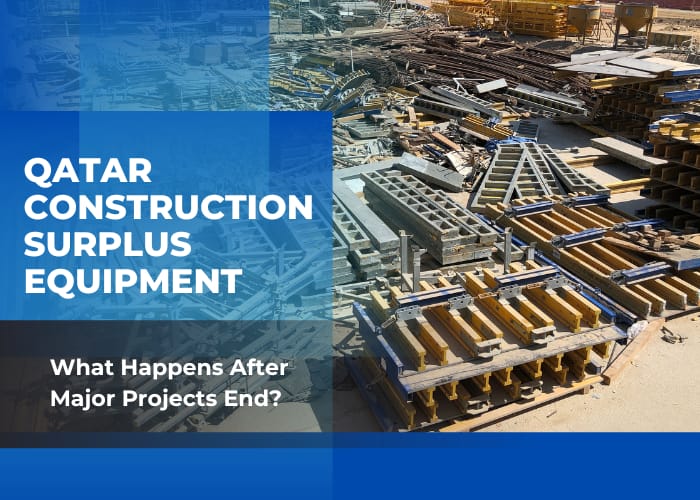
Qatar's Construction Sector and the Surplus Equipment Problem: What Happens After Major Projects End?
When a major construction or infrastructure project reaches practical completion in Qatar, the formal handover is rarely the clean ending it appears to be on paper. Contracts close, site teams demobilise, and project directors move on to the next assignment. But in warehouses across the Industrial Area, in laydown yards around Mesaieed, and in storage facilities connected to free zone logistics hubs near Doha, a significant volume of materials, equipment, and project inventory remains.
This is not an isolated problem or a symptom of careless procurement. It is a structural feature of how large-scale construction, EPC, and infrastructure projects operate in Qatar and across the wider Gulf. The combination of long supply lead times, aggressive project timelines, complex scope management, and the scale of procurement volumes involved makes some degree of surplus equipment Qatar project teams generate almost unavoidable.
Understanding why it happens, where it accumulates, and how organisations are attempting to manage it more effectively is increasingly relevant for EPC contractors, project directors, procurement managers, and supply chain teams who want to close projects more cleanly and protect working capital across their portfolio.
Why Major Projects Generate Surplus Equipment
The surplus equipment problem in Qatar's construction sector is fundamentally a consequence of how projects are procured rather than how they are built. Large EPC and infrastructure contracts in Qatar, whether covering civil works in Lusail, utility installations across the New Administrative Area, or industrial facilities in Ras Laffan and Mesaieed, are procured against design documents that will change before the project is complete.
That is not a failure of planning. It is a reality of complex construction. Engineering designs evolve as ground conditions are confirmed, as client requirements shift, and as procurement teams identify what is actually available in the market versus what was specified at tender stage. By the time the project reaches its final phases, the materials and equipment installed on site frequently differ in quantity, specification, and configuration from what was originally procured.
The gap between original procurement and actual installation is where surplus is created. Goods ordered for a specification that changed. Quantities procured against a schedule that was subsequently revised. Materials purchased to cover contingency that was never triggered. Equipment sourced as a precaution against long lead times that arrived after the need had already been resolved another way.
In a single large project, the cumulative volume of these gaps can represent a substantial inventory position. Across a contractor's portfolio of active projects in Qatar, the aggregate is often considerable.
Procurement Forecasting and Over-Ordering Challenges
Procurement teams on major Qatar construction projects operate under pressure that does not always receive adequate acknowledgment in post-project reviews. The decision to order materials early and in volume is rarely irrational. It is a calculated response to real constraints.
International supply chains serving Qatar's construction sector involve lead times that can stretch to twenty or thirty weeks for specialist items. Structural steel fabricated to project specifications, electrical switchgear configured for particular load requirements, custom-fabricated pipework, and process equipment manufactured against specific performance criteria all take time to produce and ship. A procurement team that waits for final design confirmation before placing orders risks being unable to meet the construction programme.
The rational response is to order ahead of absolute certainty. This protects the programme, reduces the risk of delays caused by material shortages, and in many cases locks in pricing before escalation occurs. The trade-off is that early procurement decisions are made against a design that has not yet been finalised, and some of what gets ordered will not ultimately be required.
Minimum order quantities from international suppliers compound this. A contractor who needs 850 units of a particular fitting may only be able to order in quantities of 1,000. The 150-unit surplus is not the result of poor planning. It is the result of supply chain structure, and it is replicated across dozens of material categories on a single project.
Forecasting models used by procurement teams also tend to build in buffers for wastage, breakage, and installation tolerance. These buffers are reasonable in isolation. Aggregated across a full project bill of materials, they contribute to an over-procurement position that becomes visible only at project close.
Scope Changes and Material Redundancy
Scope changes are among the most significant contributors to construction surplus equipment Qatar projects accumulate. In practice, no major construction or EPC project in Qatar reaches completion with the same scope it had at contract award. Client-driven variations, regulatory changes, design development, value engineering exercises, and coordination issues between disciplines all generate scope movements throughout the project lifecycle.
When scope changes occur after procurement has been completed, the materials and equipment ordered for the original scope become redundant. If structural steelwork was procured for a floor plate configuration that was subsequently revised, the procured steel does not automatically convert into an asset for the revised design. If mechanical equipment was specified for a plant room layout that was reorganised, the equipment may not fit the new arrangement.
The challenge is that procurement decisions and scope decisions are made by different teams on different timescales. Procurement teams lock in orders based on design information available at a specific point in time. Design teams develop and revise drawings on a separate cycle. The coordination between these two streams is imperfect even on well-managed projects, and the imperfection leaves a trail of redundant materials.
Variation orders go through a formal contractual process, but the physical materials associated with superseded scope do not always get tracked with equivalent rigour. They are set aside on site, transferred to laydown areas, or moved to warehouse storage while the project continues. By the time the project closes, the original context for those materials may be poorly documented, making it difficult for the organisation to assess what is genuinely surplus and what might have a use elsewhere.
Common Categories of Surplus Equipment
Across construction and EPC projects in Qatar, certain categories of surplus equipment and materials appear consistently.
Structural and civil materials including steel sections, reinforcement bar, formwork components, and specialist concrete products are among the most common. These are often over-ordered as programme protection and left with a surplus once the structural package reaches completion.
Mechanical, electrical, and plumbing materials including pipework, fittings, cable, conduit, switchgear, distribution boards, and control equipment generate surplus across both the main contract and specialist subcontract packages. The complexity of MEP coordination in large buildings means that quantities are frequently revised during construction, and materials procured for original designs may not suit revised routing or equipment layouts.
Process and industrial equipment including pumps, compressors, valves, instrumentation, and control systems is most common on EPC projects with industrial plant components. This equipment carries the highest unit values and creates the most significant asset management challenges when it becomes redundant.
Fit-out and finishing materials including specialist tiles, raised access flooring, acoustic ceiling systems, door sets, hardware, and specialist glazing products accumulate on commercial and hospitality projects. These are often procured with contingency quantities that exceed what is ultimately installed.
Consumables and site supplies including welding consumables, fixings, adhesives, sealants, safety equipment, and temporary works materials are procured at scale and frequently leave a residual inventory at project completion.
Project Closeout Inventory Reviews
The project closeout phase is the point at which surplus equipment Qatar project teams have accumulated becomes formally visible, and it is also the phase that receives the least systematic attention in many organisations.
Closeout is typically managed under time pressure. Client handover deadlines, subcontractor final accounts, and the demobilisation of site teams all create urgency to close the project down as quickly as possible. Inventory review does not carry the same urgency as defect resolution, commissioning, or documentation handover. The result is that materials and equipment audits at project close are often incomplete.
Where audits do take place, the data quality varies considerably. Materials management systems on large projects are designed to track procurement and delivery, but they are not always configured to capture what was actually consumed versus what was delivered to site. The gap between delivery records and installation records is where surplus goes unaccounted.
A well-structured project closeout inventory review on a large EPC project in Qatar would typically involve a full reconciliation between the procurement schedule, the delivery records, and the as-built material takeoffs for each discipline. In practice, this reconciliation is rarely completed at the level of detail that would give the organisation a clear and accurate picture of what surplus inventory remains and what its characteristics are.
The organisations that do invest in thorough closeout reviews consistently find that the identified surplus is higher in volume and value than initial estimates suggested. The discovery is useful. It is simply made later than it should be.
Storage and Carrying Cost Implications
Once surplus construction equipment and materials from Qatar projects enter storage, they begin accumulating costs that are easy to underestimate at the point the storage decision is made.
Warehouse and laydown space in Qatar's Industrial Area and across the free zones around Doha comes at varying rates depending on facility type, location, and contract structure. For project-specific goods, storage is often arranged quickly and on informal terms, without a clear plan for how long the goods will be held or what the exit route will be.
The cost of storage compounds quietly. A laydown yard or warehouse bay that appears affordable on a monthly basis represents a significant cost when applied over twelve or twenty-four months. Insurance on high-value plant and equipment adds to this. The management overhead of maintaining records, conducting periodic inspections, and responding to internal inquiries about stored assets is a labour cost that is rarely attributed directly to the surplus holding.
The more significant financial implication is the opportunity cost of the capital tied up in the stored assets. For an EPC contractor or construction business operating with project financing, the inability to realise the value of surplus equipment means that capital which should have been released at project close remains locked in inventory. This affects working capital availability across the portfolio, and on larger organisations with multiple projects in closeout simultaneously, the aggregate impact can be meaningful.
The decision to move goods into storage is frequently made at site level without full visibility of these carrying costs at the organisational level. A project manager who moves equipment to a warehouse to avoid a disposal decision has solved a site problem but transferred a financial problem upstream.
How Organisations Manage Surplus Assets Internally
Qatar's larger EPC contractors and construction groups have developed varying approaches to managing project surplus internally, with mixed results.
The most structured approach involves a centralised asset register that spans multiple projects and allows the organisation to match surplus from one project against requirements on another. In theory, this means that construction surplus from a completed Lusail development can be redirected to an active project in the Industrial Area or Mesaieed that has a matching requirement. In practice, the effectiveness of this approach depends entirely on the quality of the asset data and the speed at which it is updated.
Many organisations maintain asset registers in principle but find that the data becomes unreliable quickly. Items are moved without records being updated. Specifications recorded at the time of procurement do not match the physical goods after site handling. The logistics cost of transferring assets between projects, particularly for heavy plant and bulky materials, sometimes exceeds the value of the goods themselves.
Inter-project transfers work best for high-value, easily identifiable items in good condition with clear specifications. They work less well for consumables, partial quantities, and items that have been partially used or modified during the original project.
Some larger contractors in Qatar have designated specific storage facilities as internal material pools, where surplus from closed projects is held for redeployment on future work. This requires a sustained commitment to maintaining accurate inventory data and a procurement process that genuinely checks internal availability before placing new orders. Where this discipline exists, it delivers measurable results. Where it does not, the pool becomes a cost centre rather than an asset.
Lessons Learned for Future Projects
Qatar's construction and EPC sector has produced a body of practical experience around surplus equipment management over successive project cycles, and the lessons emerging from better-run project closeouts point in consistent directions.
Early procurement planning should include a formal surplus risk assessment. At the point when bulk procurement decisions are made, the procurement and project management teams should model the scenarios under which over-procurement could result and set thresholds for ordering that reflect the actual risk of non-use rather than simply the risk of shortage.
Scope change management needs stronger integration with materials tracking. When a variation order is processed that affects the material or equipment specification for a package, the procurement record for that package should be updated simultaneously to flag goods that have been rendered redundant. This requires coordination between the engineering, commercial, and supply chain teams that is frequently absent on complex projects.
Project closeout should be scheduled as a substantive phase with its own resource allocation, not treated as an administrative tail to the construction phase. A dedicated closeout team with access to full procurement, delivery, and installation records can complete a materials reconciliation that gives the organisation a genuine picture of its surplus position before site demobilisation is complete.
Carrying cost transparency should be built into storage decisions. When surplus equipment or materials are moved to warehouse storage at project close, the authorisation for that storage should include a carrying cost estimate over a defined holding period, so that the decision is made with full financial visibility rather than as a default.
Finally, lessons learned documentation should include the surplus generation outcome as a standard metric alongside the more commonly tracked programme, cost, and quality indicators. Organisations that track surplus as a project performance measure create the institutional incentive to reduce it on future work.
Conclusion
The surplus equipment problem in Qatar's construction sector is not going away. As long as large EPC, infrastructure, and development projects are procured against evolving designs, delivered against aggressive timescales, and closed out under time pressure, some level of residual inventory is a structural outcome rather than an operational failure.
What distinguishes well-run project organisations from the rest is not the absence of surplus. It is the speed and rigour with which surplus is identified at closeout, the quality of the systems used to track and redeploy it, and the institutional discipline to treat it as a financial matter rather than a site housekeeping issue.
For procurement managers, project directors, and supply chain teams operating across Qatar's construction and industrial sectors, the case for investing more systematically in closeout inventory management is straightforward: the assets are already paid for, and recovering their value is simply a matter of knowing what you have and acting on it before carrying costs erode whatever margin remains.
FAQ Section
Q1: Why do construction projects in Qatar generate so much surplus equipment?
Major projects in Qatar are procured against designs that evolve throughout the construction phase, creating gaps between what was ordered and what was actually installed. Long international lead times, minimum order quantities, and contingency buffers in procurement forecasts compound the over-ordering effect across every discipline.
Q2: What are the most common types of surplus equipment on Qatar EPC projects?
The most common categories include structural steel and civil materials, MEP components such as cable, conduit, switchgear, and pipework, process equipment including pumps and valves, fit-out and finishing materials, and site consumables left over at project completion.
Q3: When does surplus equipment typically get identified on a Qatar construction project?
Surplus is most commonly identified during the project closeout phase, when procurement records are reconciled against as-built installation quantities. On projects without a structured closeout inventory review, surplus may not be formally identified until months after practical completion.
Q4: How do scope changes on EPC projects contribute to material redundancy?
When design or scope changes are issued after procurement has been completed for the original specification, the materials ordered for the superseded scope become redundant. The gap between procurement timescales and design revision cycles means this mismatch is common on complex EPC contracts.
Q5: What is the financial impact of storing surplus construction equipment after a project closes?
Storing surplus equipment creates ongoing costs including warehouse rental, insurance, and management overhead, while the capital tied up in the inventory remains unrealised. Industry estimates for total annual holding costs across all factors typically range from 20% to 30% of the original asset value.