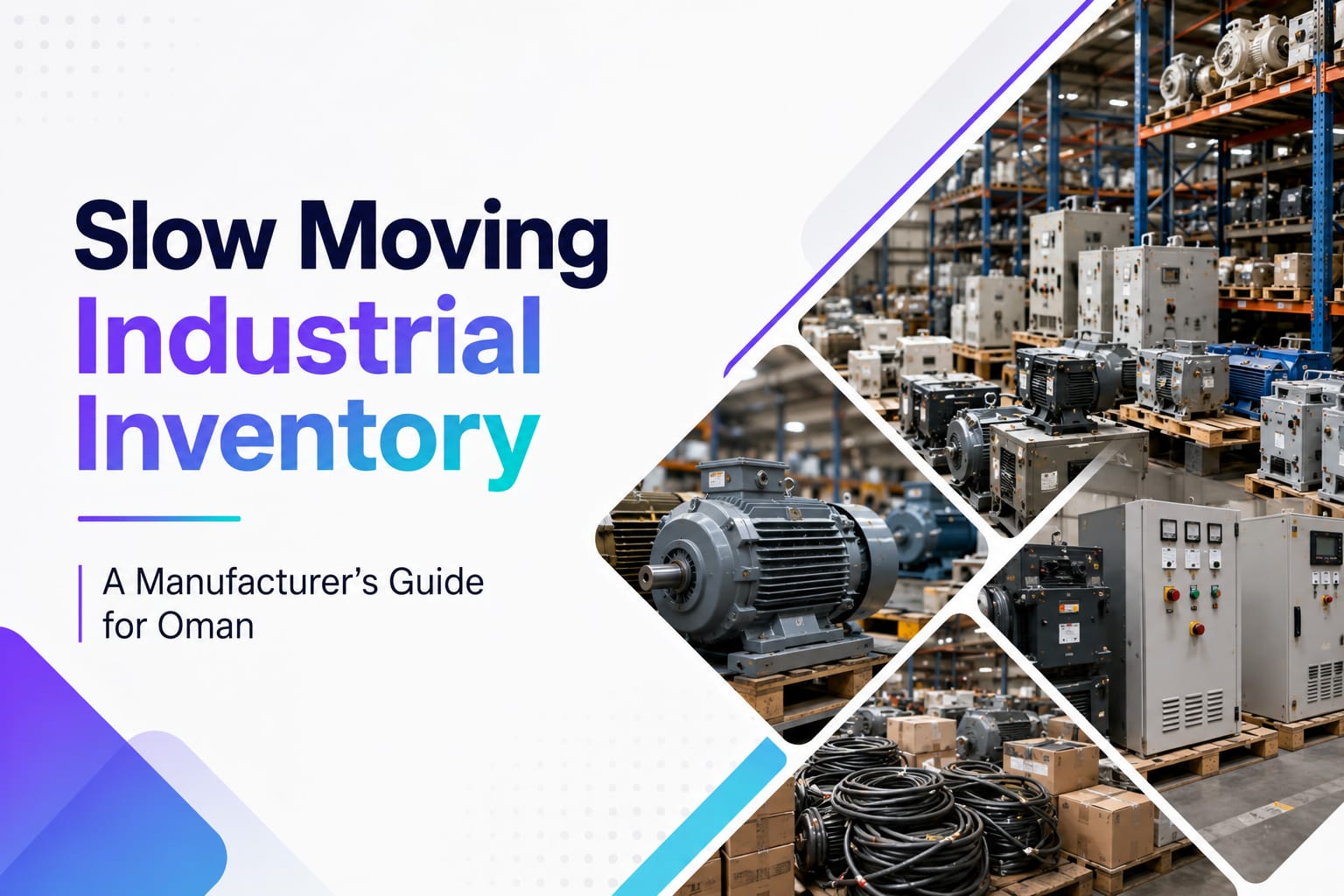
How Omani Manufacturers Can Recover Value From Slow Moving Industrial Inventory
Walk into most manufacturing sites in Oman and you will find a section of the warehouse nobody talks about much. Pallets that have not moved in a year. Raw material bought for a product line that got discontinued. Spare parts for a machine that was replaced two turnarounds ago. This is slow moving inventory, and it is far more common in Omani manufacturing than most owners admit.
It rarely shows up as a single dramatic write-off. It builds quietly, shelf by shelf, until a stock count or a warehouse expansion project forces someone to actually look at what has been sitting there.
Why Manufacturing Inventory in Oman Becomes Slow Moving
Manufacturers rarely plan to end up with dead stock. It builds up gradually, usually for a few recurring reasons.
Demand forecasts that do not hold up. Production planning in Oman often has to account for long import lead times, so factories order raw material in advance based on projected demand. When that demand shifts, the material already on site does not.
Production changeovers. When a factory switches to a new product line or updates a process, the components and packaging used for the old line often become redundant overnight.
Spare parts for retired machinery. Industrial equipment gets upgraded or replaced, but the spare parts bought for the older machine usually stay in the store room, sometimes for years, because nobody wants to be the one who writes them off. Writing off inventory often means acknowledging a purchasing decision did not pay off, which is an uncomfortable conversation few teams volunteer to have.
Over-ordering to avoid downtime. Many Omani manufacturers order extra buffer stock of critical components to protect against supply delays. That buffer is sensible in theory, but if demand does not use it up, it quietly becomes dead stock.
Packaging and labeling changes. Regulatory updates, rebranding, or a shift in export markets can make an entire batch of packaging or labeling stock unusable overnight, even though the product itself is unaffected.
None of these causes are unusual or a sign of bad management. They are a normal part of running a factory. The problem is not that slow moving stock appears, it is that most businesses do not have a system for dealing with it once it does.
Inventory Mistakes That Make the Problem Worse
A few habits turn slow moving stock into a permanent fixture rather than a temporary one.
Treating it as a storage problem, not a cash problem. Many factories see excess inventory as simply taking up warehouse space. In reality, it is capital that is not working for the business.
No clear threshold for action. Without a rule for when stock gets flagged and reviewed, "slow moving" quietly becomes "dead" with nobody deciding it should.
Poor categorization. If inventory systems do not separate active stock from aging stock, management often does not see the scale of the problem until a stock count or audit forces the issue.
Relying on manual tracking. Factories still using spreadsheets or paper-based stock cards for parts of their inventory often lose visibility over time. Aging stock gets buried among active items rather than flagged for review.
Hoping demand will return. It is common to hold on to material because a project might restart or an old customer might reorder. Sometimes that happens. More often, the stock just sits there for another year.
No single owner for the decision. In many factories, production, procurement and finance each have a partial view of the inventory problem, but nobody is specifically responsible for deciding what happens to stock once it stops moving. Without ownership, the default action is to do nothing.
What Slow Moving Stock Actually Costs Your Business
The direct cost is the money tied up in the stock itself, but that is only part of it.
- Storage costs. Warehouse space in Oman is not free, and slow moving stock occupies space that could hold active, revenue-generating inventory.
- Insurance and handling. Every pallet sitting in storage still needs to be insured, moved during layout changes, and accounted for in stock takes.
- Depreciation. Electronics, coatings, seals and many industrial components degrade over time. The longer stock sits, the less it is usually worth.
- Opportunity cost. Capital locked in unused inventory cannot be used for new equipment, working capital, or growth.
- Reporting distortion. Slow moving stock can inflate the value shown on inventory reports, giving a misleading picture of how much working capital is actually available.
For a mid-sized manufacturer, this can quietly amount to a meaningful percentage of annual working capital sitting idle in a corner of the warehouse.
There is also a less obvious cost: distorted planning. When old stock is still showing up in inventory reports, it can skew reorder calculations and demand forecasts, making it harder to plan future purchasing accurately.
Practical Ways to Recover Value From It
Audit and categorize regularly. Set a fixed schedule, quarterly works well for most factories, to review inventory age and flag anything that has not moved within a set period.
Set a clear liquidation threshold. Decide in advance how long stock can sit before it gets reviewed for disposal or sale. This removes the emotional decision-making that keeps dead stock around.
Separate slow moving from truly dead stock. Slow moving inventory may still find a buyer through discounted internal use, secondary markets, or bundled sales. Genuinely dead stock needs a faster exit.
Track the reason, not just the item. When stock gets flagged as slow moving, note why. A demand shift, a changeover, or a cancelled order each point to a different root cause. Over time, this record helps identify which part of the ordering process is generating the most excess, so it can be adjusted going forward rather than repeating the same pattern every year.
Assign clear ownership. Give one role, often finance or operations, responsibility for reviewing flagged stock and making a disposal decision within a set timeframe. This closes the gap that lets stock sit indefinitely.
Bring in a bulk buyer for larger volumes. When the volume is too large for piecemeal disposal, working with an established dead stock buyer in Oman is often faster and more cost-effective than trying to sell smaller lots one at a time. It also keeps the disposal private, without advertising your surplus to competitors or customers.
Getting ahead of slow moving inventory is mostly a matter of building the habit of reviewing stock regularly, rather than waiting until a warehouse audit forces the conversation. Factories that treat this as a routine finance and operations task, rather than an occasional cleanup project, tend to recover far more value from their surplus over time.
FAQ
What counts as slow moving inventory in a manufacturing setting?
It generally refers to stock that has not been used, sold, or moved within a set period, often three to six months, depending on the industry and product type.
How often should manufacturers in Oman audit their inventory?
Quarterly reviews work well for most factories, though high-turnover operations may benefit from monthly checks on flagged items.
Is slow moving inventory the same as dead stock?
Not quite. Slow moving stock still has some chance of being used or sold. Dead stock has effectively no active demand left and needs a different disposal approach.
Can slow moving inventory be sold before it becomes fully obsolete?
Yes, and this is usually the better outcome. Catching it early, through internal audits or regular category reviews, gives you more options than waiting until it has no resale value left.