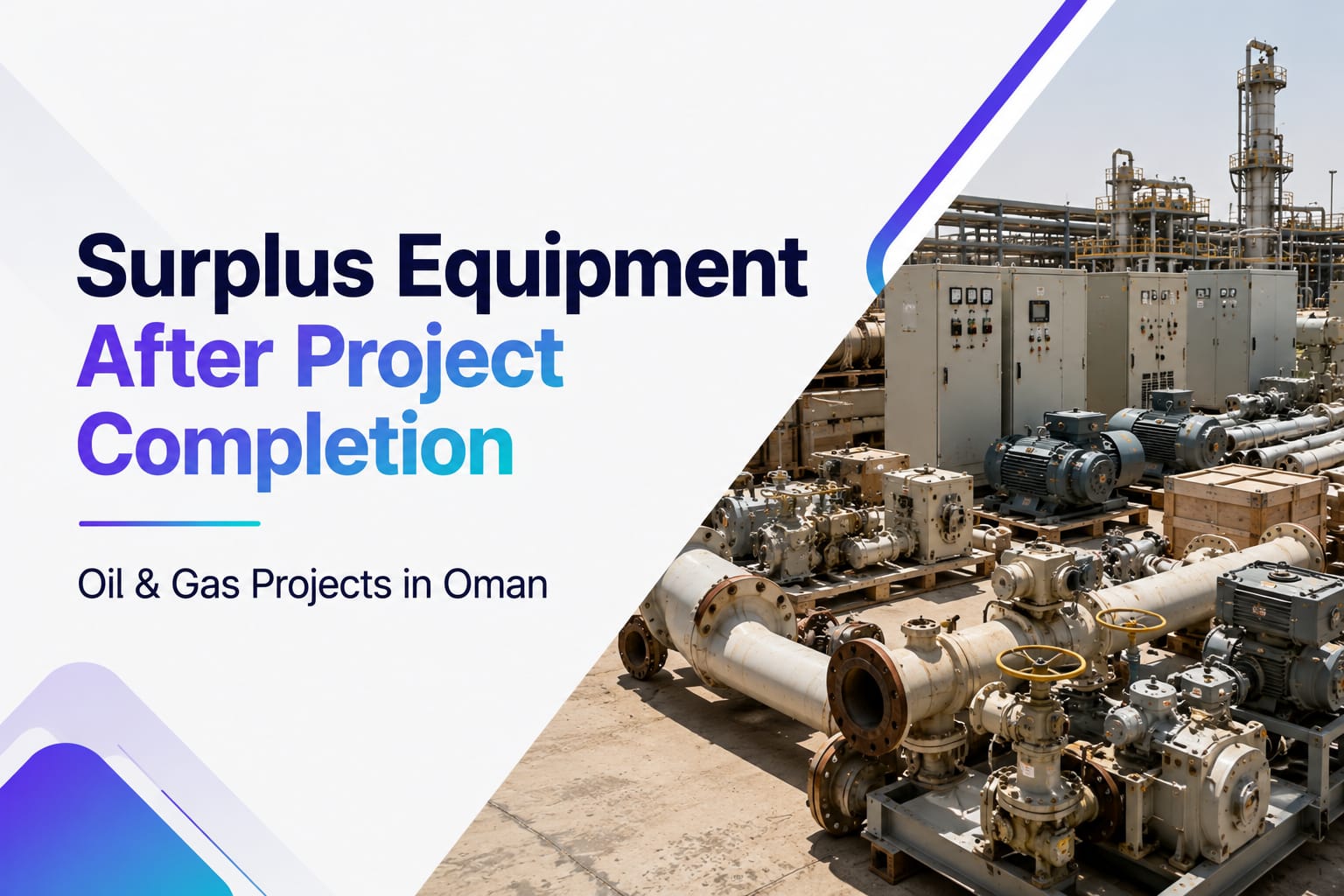
Why Oil and Gas Projects in Oman End Up With Surplus Equipment After Completion
Surplus equipment is one of the most predictable outcomes of oil and gas project work in Oman, yet it still catches procurement and project teams off guard at closeout. Understanding why it happens is the first step to planning around it on the next project.
It is worth being clear about what this surplus actually is. It is rarely defective or unusable material. In most cases, it is perfectly functional equipment that simply no longer has a defined role in the project it was bought for.
Project Timelines Rarely Match Original Procurement Plans
Most large oil and gas projects in Oman, whether around Sohar's industrial cluster or Duqm's refinery and petrochemical developments, are procured against an initial schedule. Contracts get extended for regulatory approvals, weather delays, or contractor availability. Equipment ordered against the original timeline often arrives before it is needed, or in some cases after the phase it was meant for has already moved on to a different scope.
When a project timeline shifts by even a few months, materials procured months in advance rarely get reabsorbed cleanly into the revised plan.
Weather is a particular factor in Oman, where seasonal conditions along the coast can delay marine logistics and site access for offshore-adjacent developments. A delay of a few weeks in shipping or site mobilization can leave already-delivered equipment sitting in storage well beyond its planned installation window, with no adjustment made to the procurement plan that ordered it.
Procurement Decisions Made Early Create Surplus Later
Procurement for oil and gas work happens under pressure to avoid downtime. Long lead times for specialized equipment mean teams often order early and order generously, and that pattern is reinforced by how procurement performance is typically measured, on schedule adherence rather than on how closely final consumption matches what was ordered.
Bulk ordering to secure pricing and delivery slots. Vendors frequently require minimum order quantities or offer better terms for bulk purchases, which pushes procurement teams to buy more than the immediate scope needs.
Buffer stock policies. Contractors build in safety margins for critical components, valves, fittings, instrumentation, because a shortage mid-project is far more costly than holding a bit of extra stock. That buffer often outlives the project.
Multiple contractor overlap. On large projects with several contractors working in parallel, each team may independently procure similar materials without full visibility into what others already have on site.
Long-lead item ordering ahead of final design freeze. Items with extended manufacturing times, such as specialized valves, rotating equipment or instrumentation packages, are often ordered before the engineering design is fully locked, simply to protect the schedule. If the design later shifts, some portion of that early order no longer matches what gets built.
Engineering Revisions Leave Materials Without a Use
Engineering specifications on oil and gas projects change more often than procurement schedules assume. A pipe spec change, a vendor substitution, or a design revision made after materials have already been ordered or delivered leaves the original stock without a clear application.
This is especially common on projects where front-end engineering design is fast-tracked to meet a start date, and detailed engineering catches up later. By the time the detailed design is locked, some of the originally procured equipment no longer fits the final specification.
Vendor substitutions add to this. If a preferred supplier cannot meet a delivery date, procurement teams sometimes switch to an alternative vendor with slightly different specifications. The originally ordered items from the first vendor do not simply disappear. They stay on site, recorded in inventory, without a defined role in the finished project.
Project Closeout Is Where Surplus Becomes Visible
Surplus accumulates gradually through the life of a project, but it usually only becomes visible at closeout. As a project demobilizes, teams do a final stock reconciliation and discover the gap between what was procured and what was actually installed or consumed.
Handover to operations teams typically only covers equipment that is installed and commissioned. Anything left in laydown yards or warehouses becomes the contractor's or client's responsibility to deal with separately, and it often sits there for months before anyone actively manages it.
Contract structure plays a role too. On many EPC contracts in Oman, responsibility for leftover materials is not clearly assigned in the original agreement. Once the project team demobilizes and moves on to the next contract, there is often nobody left with the authority or incentive to actively manage what remains on site.
Equipment Replacement Cycles Add to the Pile
Operating assets in Oman's oil and gas sector go through planned replacement and upgrade cycles. When equipment is replaced ahead of failure, for reliability upgrades, efficiency improvements, or obsolescence, the older equipment is frequently still functional. It gets moved to storage rather than scrapped, because it still has some residual value, but it is no longer part of active operations.
Over several replacement cycles, this creates a growing inventory of decommissioned but usable equipment that nobody has a clear plan for.
This is particularly visible during turnaround and shutdown periods, when operators replace multiple systems at once to minimize downtime. A single planned shutdown can generate several years' worth of decommissioned equipment in a matter of weeks, arriving in storage faster than most sites have a process to deal with it.
MRO Inventory Is Often the Largest Hidden Surplus
Maintenance, repair and operations inventory tends to accumulate the most quietly. Spares are purchased against specific equipment models to avoid unplanned downtime. When that equipment is later replaced or decommissioned, the associated spares usually remain in the stores system, sometimes for years, because they are technically still "in stock" even though there is nothing left for them to be used on.
Combined across multiple equipment generations, MRO surplus can end up representing a significant share of a site's total stored inventory value, much of it unlikely to ever be issued again. This is the same underlying pattern seen in manufacturing environments, where slow moving industrial inventory in Oman builds up for similar reasons: procurement decisions made in advance of actual, evolving need.
Part of the difficulty is that MRO stock is rarely reviewed with the same scrutiny as capital project material. It sits under a stores budget rather than a project budget, so it does not get the same closeout attention that project surplus receives when a contract ends. It can accumulate for years before anyone runs a dedicated review of what is actually still relevant to current operations.
Recognizing these patterns during project planning, rather than only at closeout, gives procurement and project teams a much better starting point for deciding what to do with the surplus once a project winds down. Building a periodic surplus review into project governance, alongside the usual cost and schedule reporting, is a straightforward way to catch this earlier rather than discovering the full scale of it only once demobilization is underway.
FAQ
Why does surplus equipment appear even on well-managed oil and gas projects? Because procurement decisions are made early, against a schedule and specification that almost always changes before the project finishes. Surplus is a byproduct of managing long lead times and technical risk, not necessarily a sign of poor planning.
Does surplus mostly show up at project closeout, or does it build up earlier?
It builds up gradually throughout the project, largely from bulk ordering and buffer stock, but it usually only becomes visible and quantified during closeout reconciliation.
Is MRO inventory surplus different from project material surplus?
Yes. Project material surplus comes from procurement made against a build schedule. MRO surplus comes from spares purchased against specific operating equipment that is later replaced or decommissioned, so it tends to accumulate over a much longer timeframe.
Can engineering changes really leave already-procured equipment unusable?
Yes, particularly when front-end design is fast-tracked. Detailed engineering can finalize specifications after equipment has already been ordered, leaving the original procurement without a clear application in the finished design.